 LINGCORE SCI
LINGCORE SCI
LINGCORE SCI
Analyze papers, build evidence-aware reviews, and identify suitable journals with structured AI-assisted workflows designed for clinical and biomedical research.
Turn a DOI, PMID, abstract, or paper into a structured review of study design, PICO, methods, bias, and clinical interpretation.
Try Paper Analyzer →Organize verified sources into an evidence-aware review workflow with clear claims, comparisons, and citation boundaries.
Build a Review →Compare candidate journals by scope, study design, manuscript type, reporting expectations, and submission fit.
Match a Journal →Connect important claims to identifiable sources and make evidence boundaries visible.
Keep study design, estimands, bias, reporting, and clinical interpretation in view.
AI assists the workflow; researchers verify evidence and own the final decision.
Start with a DOI, PMID, abstract, or manuscript and identify the study design, PICO structure, methods, limitations, and clinical interpretation questions.

Organize findings, compare studies, and connect claims with traceable references through a structured evidence-aware review workflow.
Check reporting completeness, clarify methodological risks, and identify journals that fit your manuscript and study design.
A connected guide to causal methods, sequential decisions, and evidence generation for medical researchers.

Learn how cumulative-logit models preserve ordered clinical outcomes, when proportional odds is defensible, and how to report category probabilities.
Read Article →
Learn how hierarchical pairwise comparisons prioritize clinically important outcomes and why win difference, component drivers, and absolute measures matter.
Read Article →
Learn how BMA combines plausible models to reduce overconfident variable-selection claims while preserving priors, diagnostics, calibration, and validation.
Read Article →
Learn how causal forests estimate conditional treatment effects and why honesty, calibration, regression comparison, and external validation remain essential.
Read Article →
Learn when Firth logistic regression helps with sparse binary outcomes and separation, and why calibration, validation, and researcher judgment still matter.
Read Article →
Learn how ITS estimates level and slope changes while addressing autocorrelation, seasonality, concurrent events, controlled designs, and reporting boundaries.
Read Article →
Learn how TMLE links estimands, outcome and treatment models, machine learning, cross-fitting, positivity diagnostics, uncertainty, and sensitivity analysis.
Read Article →
Learn how GAMs model nonlinear clinical associations with smooth functions, effective degrees of freedom, uncertainty bands, diagnostics, and validated interpretation.
Read Article →
Learn how measurement error affects exposures, outcomes, biomarkers, and prediction models, and how validation, calibration, SIMEX, and sensitivity analysis address it.
Read Article →
Learn how joint models connect repeated biomarker trajectories with event risk through shared latent structure, informative dropout handling, and dynamic validation.
Read Article →
Learn how landmark analysis defines future-risk populations, uses time-varying clinical information, avoids temporal leakage, and validates dynamic predictions.
Read Article →
Learn how to model overdispersed clinical counts, use exposure-time offsets, assess excess zeros and clustering, and interpret incidence rate ratios responsibly.
Read Article →
Learn how restricted cubic splines preserve continuous information, model nonlinear clinical associations, test curvature, and support interpretable, validated risk curves.
Read Article →
Learn how research skills support literature searching, paper appraisal, statistical planning, evidence-driven writing, citation mapping, and manuscript quality control without replacing researcher judgment.
Read Article →
Learn how intracluster correlation, design effects, cluster-size variation, and cluster-aware models shape power and valid inference in cluster-randomized trials.
Read Article →
Learn when and how to adjust for baseline covariates in randomized trials, from ANCOVA to principled estimators, conditional versus marginal effects, and regulatory reporting.
Read Article →
Learn how multivariate meta-analysis jointly models correlated outcomes, borrows strength across endpoints, handles missing outcomes, and supports valid joint inference.
Read Article →
Learn how to detect, quantify, and adjust for publication bias using funnel plots, small-study-effect tests, trim-and-fill, selection models, and GRADE-based reporting.
Read Article →
Learn how TSA applies sequential monitoring boundaries to cumulative meta-analysis, estimates required information size, and provides adjusted confidence intervals.
Read Article →
Learn how to jointly model sensitivity and specificity, handle threshold effects, assess heterogeneity, and report QUADAS-2 and PRISMA-DTA results.
Read Article →
Learn how treatment policy, hypothetical, composite, principal-stratum, and while-on-treatment strategies answer different real-world clinical questions.
Read Article →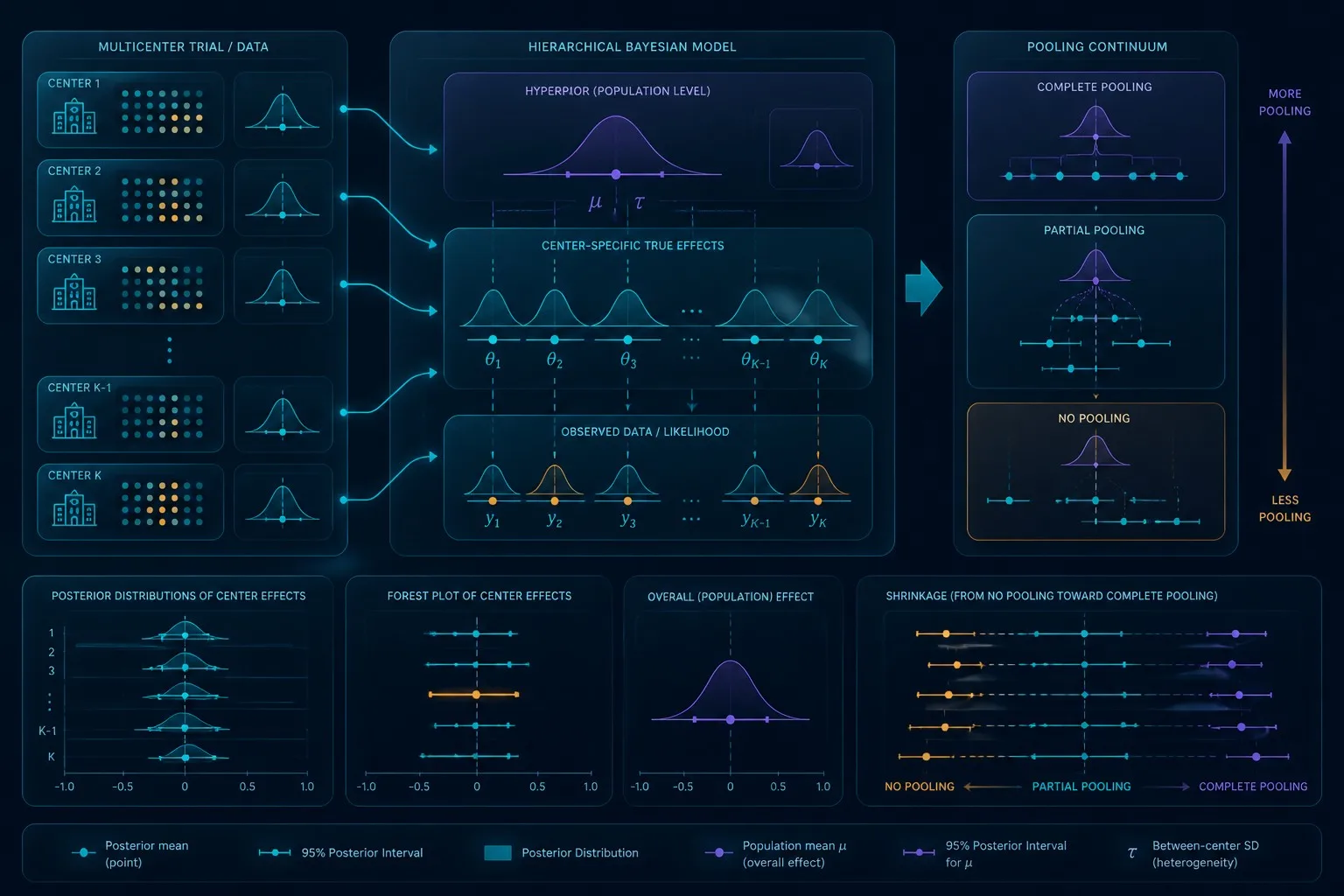
Learn how partial pooling estimates center-specific effects, stabilizes sparse subgroups, and quantifies heterogeneity without hiding uncertainty.
Read Article →
Learn how randomized crossover periods, washout, carryover assessment, and within-person analysis can support rigorous individualized treatment decisions.
Read Article →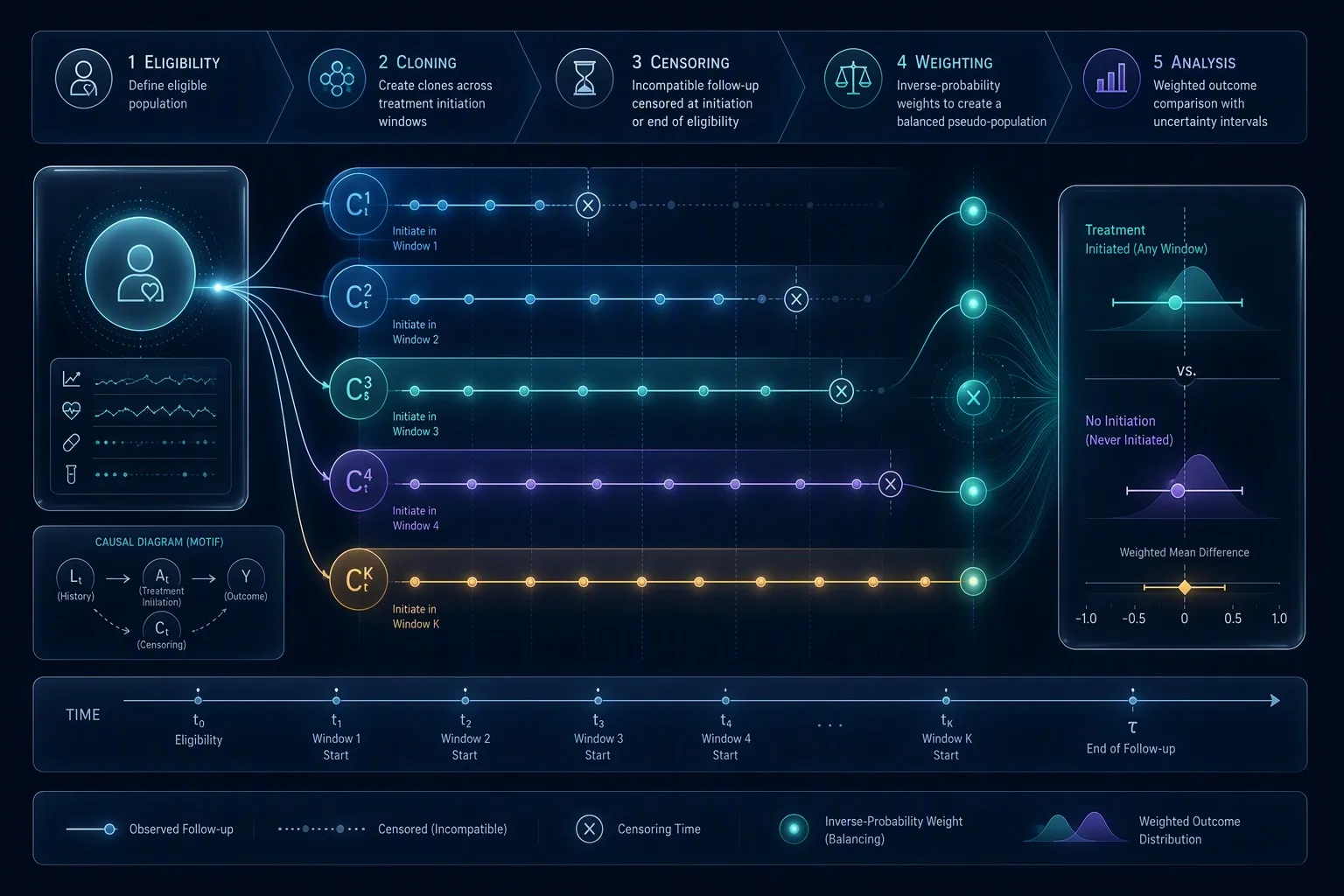
Learn how cloning, artificial censoring, and inverse probability of censoring weights emulate treatment-initiation strategies while addressing immortal-time and selection bias.
Read Article →
Randomized trials estimate internally valid effects, but the target-population effect may differ. Learn how to define effect modifiers, assess positivity, and use standardization or sampling weights.
Read Article →
One pooled AUC can conceal clinically important disparities. Learn how to assess subgroup calibration, discrimination, error rates, thresholds, and net benefit.
Read Article →
Test model generalizability across hospitals, studies, regions, or time periods by leaving one meaningful cluster out at a time and quantifying heterogeneity.
Read Article →
External validation shows where a model fails; updating determines how to repair it. Learn when to use recalibration, revision, predictor extension, shrinkage, and independent validation.
Read Article →
A model that performs well in development data is not automatically transportable. Learn how to assess discrimination, calibration, clinical utility, recalibration, and external validity.
Read Article →
Missing data analysis starts with the estimand. Learn MCAR, MAR, MNAR, multiple imputation, pattern-mixture models, delta adjustment, and sensitivity analysis for regulatory-grade trials.
Read Article →Start with one paper free, build your evidence workflow, or request a structured review before submission.