Time-Dependent ROC and Dynamic AUC in Survival Prediction
Time-dependent ROC analysis evaluates how well a survival prediction score separates patients with different event histories at a clinically defined time, while dynamic AUC summarizes that discrimination after accounting for censoring and, when relevant, competing risks.
Clinical prediction models rarely operate on a fixed binary outcome. A patient may experience an event during follow-up, remain event-free at a landmark, or become censored before the outcome is known. The familiar binary ROC curve does not describe these changing risk sets. Time-dependent ROC methods adapt sensitivity, specificity, and area under the curve to a prediction horizon, allowing researchers to ask a precise question: how well does the model rank patients according to event risk at time t?
Why a standard ROC curve is insufficient for survival outcomes
A conventional ROC curve assumes that every individual has a known binary status and a marker measured for the same classification task. Survival data violate both assumptions. Event status depends on time, and censoring prevents direct classification for some patients. A model can have strong discrimination at 30 days but weaker discrimination at 2 years. A single pooled ROC analysis can hide that time variation or treat censored observations as if their event status were known.
Time-dependent discrimination therefore requires three decisions before any software is used: the prediction score, the time horizon, and the definition of cases and controls. The score may be a baseline marker, a Cox model linear predictor, a predicted survival probability, or a dynamic prediction updated with longitudinal information. The horizon may be a fixed time such as 1 year or a grid of clinically relevant times. The case-control definition determines what clinical question the AUC answers.
| Element | Decision | Interpretation consequence |
|---|---|---|
| Prediction score | Risk score, survival probability, cumulative incidence, or dynamic prediction. | Higher scores must correspond consistently to higher or lower risk before the AUC is interpreted. |
| Horizon | One or more clinically meaningful times, denoted by t. | Discrimination is horizon-specific; it is not a universal property of the model. |
| Cases | Events near t or events by t, depending on the estimand. | Defines whether the analysis targets incident risk or cumulative risk. |
| Controls | Event-free after t or event-free at t. | Changes the comparison set and the clinical interpretation of specificity. |
| Censoring approach | Kaplan–Meier, inverse probability of censoring weighting, risk-set, or model-based estimation. | Determines whether incomplete follow-up is handled transparently and under stated assumptions. |
Incident/dynamic and cumulative/dynamic definitions
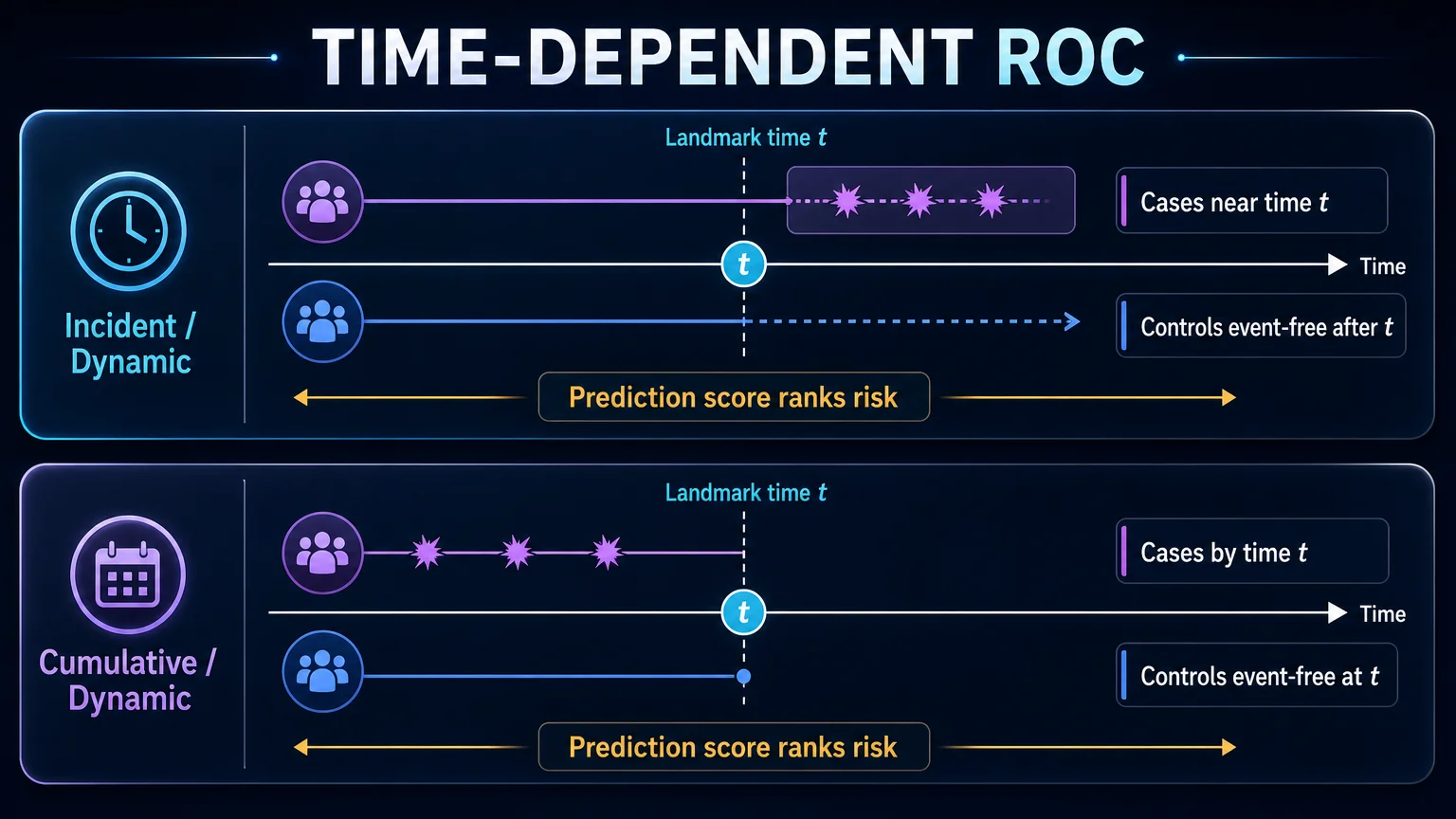
In an incident/dynamic framework, cases are individuals who experience the event at or near the time of interest, while controls are individuals who remain event-free beyond that time. The comparison is local in time. This definition is useful when the scientific question concerns who is about to experience the event, but it can be sensitive to the chosen event window and the number of events at late follow-up.
In a cumulative/dynamic framework, cases are individuals who experience the event by time t, and controls are those who remain event-free at t. The analysis targets cumulative risk by a horizon, which often matches clinical questions such as “who is likely to develop the outcome within the next year?” The two definitions are not interchangeable. A manuscript should name the definition, horizon, event coding, and control set rather than reporting “time-dependent AUC” as if it were a single metric.
The choice should follow the intended use of the prediction model. A triage tool for near-term deterioration may favor an incident interpretation. A risk calculator that reports 5-year absolute risk may align more naturally with a cumulative/dynamic interpretation. Neither definition is universally superior; each answers a different question and relies on different assumptions about the event process and follow-up.
What dynamic AUC means
At a fixed time t, the dynamic AUC is the probability that a randomly selected case receives a higher-risk prediction score than a randomly selected control, with the exact case-control sampling determined by the chosen time-dependent definition. An AUC near 0.5 indicates ranking no better than chance under that definition; values closer to 1 indicate stronger discrimination. The metric is about ranking, not calibration, absolute risk accuracy, or clinical benefit.
A high dynamic AUC does not prove that predicted probabilities are numerically correct. A model can rank patients well while systematically overestimating risk. Conversely, a well-calibrated model may have limited discrimination if patients have similar risks. Dynamic AUC should therefore be interpreted with calibration, prediction error, and clinical utility measures rather than used as a stand-alone performance claim.
Handling right censoring
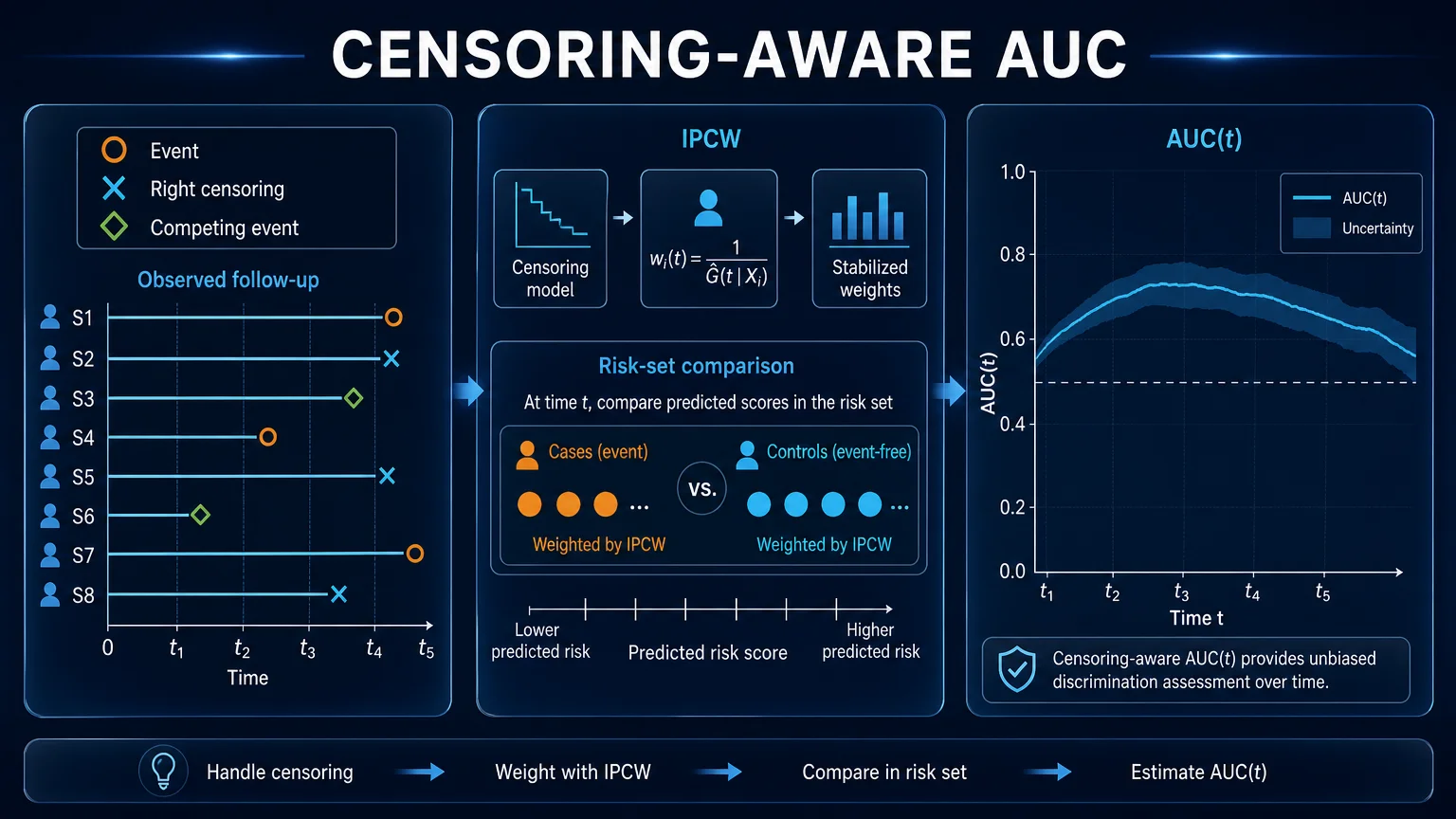
Right censoring means that the event status after the censoring time is unknown. Treating every censored patient as event-free can bias discrimination estimates, especially when censoring is common or related to predicted risk. Time-dependent ROC methods use assumptions and estimators that recover information from incomplete follow-up. Common approaches include Kaplan–Meier weighting, inverse probability of censoring weighting, risk-set methods, and model-based estimators.
Inverse probability of censoring weighting assigns more influence to observations that represent patients with similar histories who were less likely to remain observed at the relevant time. The censoring model may use baseline covariates, time-varying history, or other predictors of follow-up, depending on the design. Extreme weights indicate limited support and can make AUC estimates unstable. Analysts should inspect the censoring model, weight distribution, effective sample size, and positivity rather than treating the weighting step as a technical detail.
Administrative censoring at a fixed study end is different from informative loss to follow-up. Both may appear as incomplete observation, but the assumptions and diagnostics differ. The report should describe how censoring occurred, which variables were used to model observation, whether censoring differed by prediction score, and how uncertainty was estimated.
Competing risks change the estimand
When a competing event prevents the event of interest from occurring, the definition of a “case” and “control” must be explicit. For example, death from another cause may preclude cancer recurrence, while discharge may preclude an in-hospital complication. Treating competing events as ordinary censoring can answer a cause-specific question under a hypothetical world in which the competing event does not occur, but it may not answer the clinical question about observed cumulative incidence.
Competing-risk time-dependent AUC methods distinguish alternative targets, including cause-specific discrimination and discrimination for the cumulative incidence of the event of interest. The same prediction score can have different AUC estimates under these definitions. A model intended to predict the probability of a clinically observable event by a fixed horizon should generally align its evaluation with the corresponding cumulative incidence framework and state how competing events were handled.
Competing risks also affect calibration. A prediction of cause-specific failure probability is not the same as a prediction of cumulative incidence in the presence of competing events. The event definition, prediction target, ROC/AUC estimator, calibration plot, and Brier score should describe the same estimand whenever possible.
Dynamic AUC is not calibration or the Brier score
| Metric | Primary question | What it does not show |
|---|---|---|
| Dynamic AUC | Does the score rank cases above controls at a specified time? | Whether predicted probabilities match observed risk or whether decisions improve. |
| Calibration-in-the-large | Is average predicted risk aligned with average observed risk? | Whether individual rankings are useful. |
| Calibration slope or plot | Are predictions too extreme or too weak across the risk range? | Discrimination under a different population or horizon. |
| Brier score | How large is the overall squared prediction error at a time or across follow-up? | Which component reflects ranking versus probability miscalibration without decomposition. |
| Decision curve analysis | Does using the model provide net benefit across threshold probabilities? | Statistical discrimination independent of a decision threshold. |
Validation and optimism control
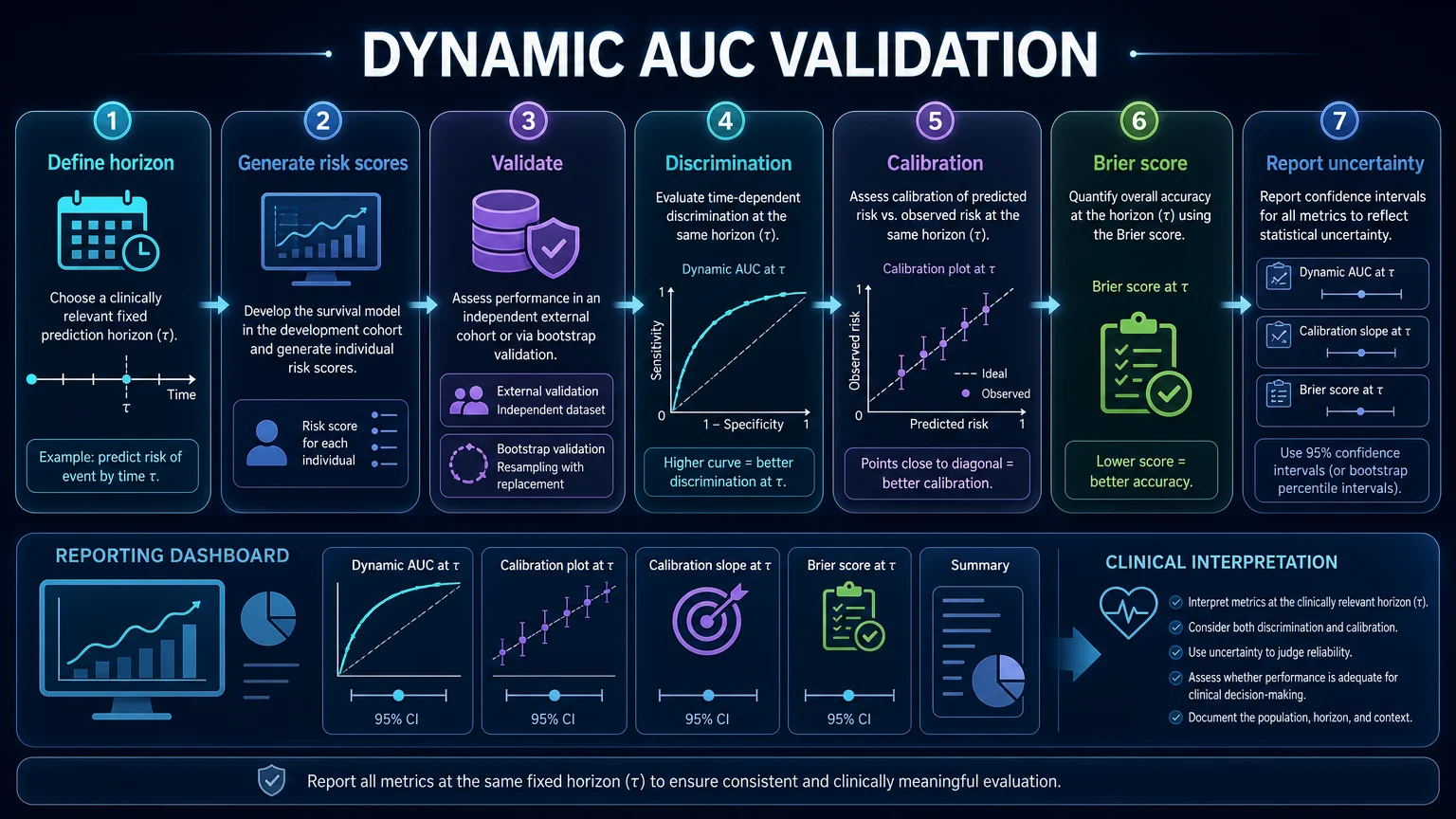
Evaluating dynamic AUC in the development sample usually produces optimistic performance. The same data select predictors, estimate coefficients, and evaluate ranking. Bootstrap optimism correction, cross-validation, temporal validation, geographic validation, or external validation can address different sources of optimism. The validation design should match the intended deployment setting.
Prediction horizons must remain aligned between development and validation. A 1-year AUC calculated in one cohort cannot be compared casually with a 5-year AUC in another cohort. The event rate, censoring distribution, competing-event process, measurement timing, and case-mix spectrum can all change the result. A lower external AUC may reflect transportability limitations rather than a computational error, while a higher value may reflect a narrower or easier validation population.
Confidence intervals should account for the survival outcome and resampling or clustering structure. When comparing two models on the same patients, paired inference is preferable to treating AUC estimates as independent. A report should distinguish a confidence interval for one AUC from a confidence interval for the difference between models.
Five-step workflow for time-dependent ROC analysis
| Step | Action | Deliverable |
|---|---|---|
| Step 1: Define the prediction horizon | Choose clinically justified time points and state the event of interest, competing events, and prediction target. | Horizon and estimand specification. |
| Step 2: Define cases and controls | Select incident/dynamic or cumulative/dynamic definitions and document how censoring enters the case-control construction. | Case-control and censoring rules. |
| Step 3: Generate fixed risk scores | Obtain predictions without leaking validation outcomes; use a consistent direction and scale for all models. | Locked prediction scores and model version. |
| Step 4: Estimate dynamic performance | Calculate AUC(t) with a censoring- or competing-risk-appropriate estimator and uncertainty interval; add calibration and Brier score. | Horizon-specific discrimination and prediction-error results. |
| Step 5: Validate and interpret | Use resampling or external data, compare models with paired inference, and interpret performance in the target population. | Validation report with clinical interpretation and limitations. |
Evidence Summary Table
| Source | Evidence role | Practical contribution |
|---|---|---|
| Heagerty & Zheng, Biometrics 2005 | Foundational survival ROC methodology | Develops time-dependent sensitivity, specificity, ROC curves, and accuracy summaries for survival models. |
| Saha & Heagerty, Biometrics 2010 | Competing-risk methodology | Addresses time-dependent predictive accuracy when competing risks affect event ascertainment. |
| Blanche et al., BMC Medical Research Methodology 2020 | Inference under competing risks | Develops inference for time-dependent prognostic accuracy measures with right-censored competing-risk outcomes. |
| Royston & Altman, model validation review | Validation framework | Places discrimination, calibration, prediction error, and validation within a broader survival-model assessment strategy. |
| TRIPOD Statement | Reporting guideline | Supports transparent reporting of prediction-model development, validation, predictors, outcomes, and performance estimates. |
Common reporting errors
- Reporting one overall AUC for a survival model without naming the prediction horizon or time-dependent definition.
- Using a binary ROC analysis that treats censored patients as event-free without justification.
- Comparing models using different horizons, case definitions, validation samples, or competing-risk estimands.
- Interpreting dynamic AUC as probability calibration, causal evidence, or clinical utility.
- Reporting an apparent development-sample AUC without optimism correction or external validation.
- Omitting confidence intervals, censoring assumptions, weight diagnostics, or the number of events supporting late-horizon estimates.
Researcher’s Toolkit
Use Lingcore SCI tools to connect survival prediction evaluation with publication decisions:
- Paper Analyzer: audit time-dependent ROC definitions, censoring assumptions, competing-risk estimands, and validation claims.
- Review Builder: organize evidence on dynamic AUC, calibration, Brier score, and survival-model validation with traceable citations.
- Journal Matcher: identify journals aligned with clinical prediction, survival analysis, biostatistics, and medical AI methodology.
Conclusion
Time-dependent ROC and dynamic AUC methods make survival-model discrimination answerable at clinically meaningful horizons. Their validity depends on more than plotting a curve: researchers must define the case-control estimand, handle censoring, account for competing risks when present, lock prediction scores before validation, and report uncertainty. A strong evaluation pairs horizon-specific discrimination with calibration, Brier score, validation, and clinical interpretation. The result is not a single universal measure of model quality, but a transparent description of how a model ranks risk for a defined population, event, horizon, and use case.