 LINGCORE SCI
Principal Stratification in Clinical Trials
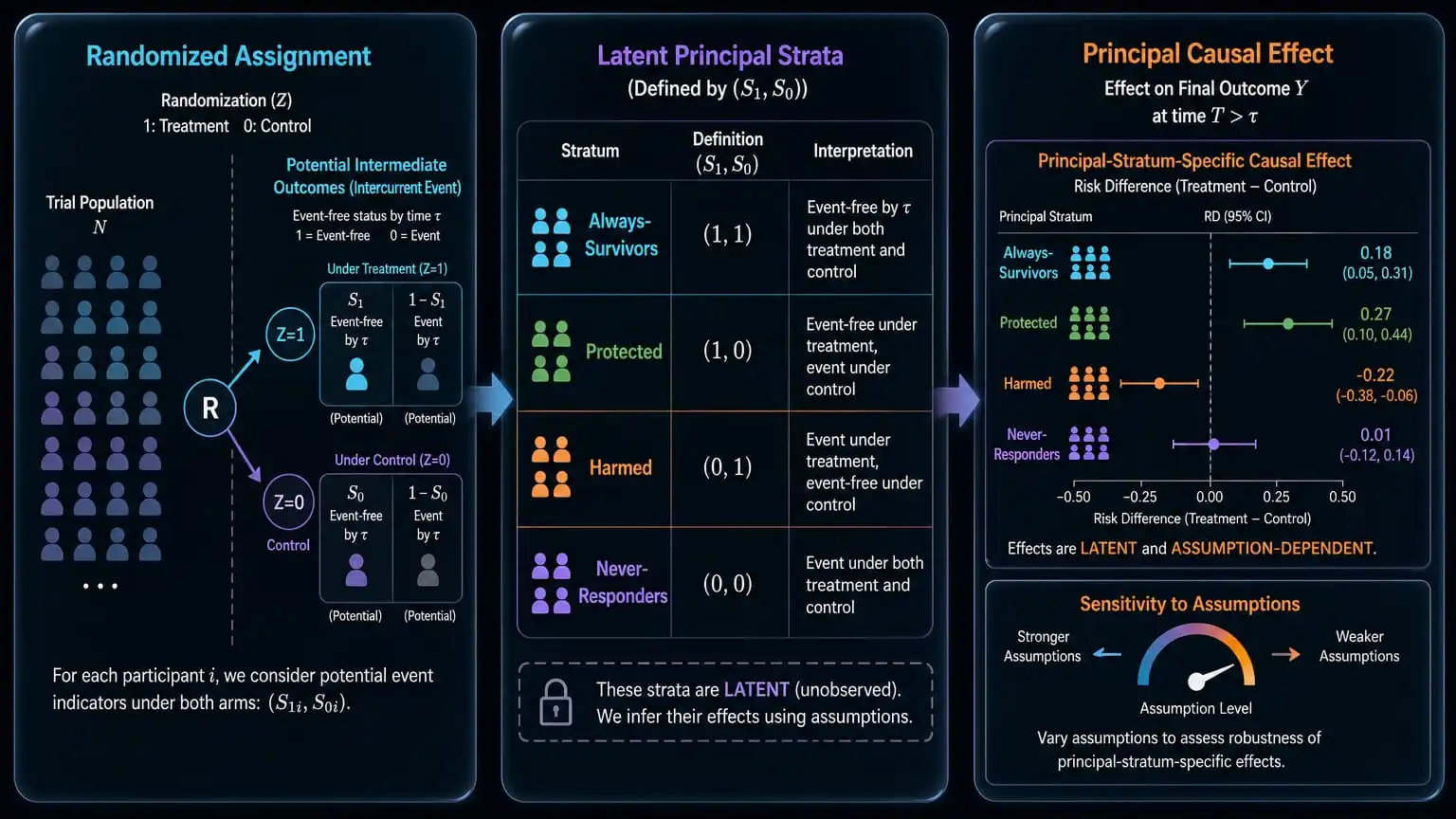
Principal stratification defines latent subgroups by participants’ joint potential outcomes for a post-randomization variable. It can target effects among always-survivors, compliers, protected patients, or other principal strata, but those groups are usually unobserved. Estimates therefore depend on design, cross-world assumptions, monotonicity or exclusion restrictions, and sensitivity analyses; a principal-stratum effect is not automatically the intention-to-treat effect.
Why post-randomization variables create a causal problem
Randomization identifies the intention-to-treat effect when treatment assignment is implemented and outcomes are observed according to the trial protocol. Clinical trials also produce variables after randomization: treatment receipt, adherence, rescue medication, biomarker response, hospitalization, survival, withdrawal, and other intercurrent events. These variables may affect how an investigator wants to interpret the outcome, but conditioning on an observed post-treatment variable can destroy the protection provided by randomization.
Consider a trial in which treatment assignment affects whether a patient receives a rescue intervention, and rescue intervention is also related to prognosis. Comparing treated and control patients within the observed rescue groups can mix treatment effects with selection effects. The subgroup “patients who received rescue treatment” is not a baseline randomized subgroup. Its composition may differ across arms because treatment assignment helped determine membership.
Principal stratification addresses this problem by defining subgroups through potential values of the post-randomization variable under every treatment assignment. The strata are counterfactual: they classify a participant according to what would have happened under treatment and under control, even though only one of those potential values is observed for each participant.
The potential-outcome definition
Let Z denote randomized assignment, S an intermediate or intercurrent-event variable, and Y the final outcome. For a binary intermediate variable, each participant has two potential values:
The principal stratum for participant i is defined by the pair (S1i, S0i). The principal-stratum-specific causal effect compares the potential final outcomes under treatment and control within that latent subgroup:
The definition is conceptually simple but empirically difficult. A participant assigned to treatment reveals information about S1, not S0. A participant assigned to control reveals information about S0, not S1. The joint pair is therefore only partially observed.
Common principal strata
| Stratum | Potential intermediate outcomes | Illustrative interpretation |
|---|---|---|
| Always-event-free or always-survivor | (S1, S0) = (1,1) | The participant would remain event-free or survive under either assignment by the specified time. |
| Protected | (1,0) | The intermediate event is avoided under treatment but occurs under control, depending on how the variable is coded. |
| Harmed | (0,1) | The intermediate event occurs under treatment but not control. |
| Never-event-free or never-responder | (0,0) | The participant has the intermediate event under both assignments or does not respond under either assignment. |
The labels depend on coding and clinical context. “Protected” may refer to survival, absence of toxicity, treatment receipt, or biomarker response. Researchers should define the variable and direction before naming strata. A label is not a substitute for the counterfactual definition.
Principal stratification is not ordinary subgroup analysis
A baseline subgroup such as age below 65 years is observed before randomization. Randomization remains valid within that subgroup if the trial and analysis support the comparison. A principal stratum is different: membership is determined by potential post-randomization values and is generally unobserved.
This distinction matters for interpretation. An analysis that reports the treatment effect among “patients who adhered” may be describing a post-treatment selected subgroup. An analysis that targets the effect among “compliers” is a principal-stratification analysis only if compliance strata are defined through potential compliance under both assignments and the identifying assumptions are stated.
Principal stratification should also be distinguished from mediation. A mediator is an intermediate variable through which treatment may operate. A principal stratum is a latent subgroup defined by joint potential values of that variable. Conditioning on a principal stratum does not automatically identify a natural direct effect, and a principal-stratum-specific contrast should not be relabeled as mediation without a separate causal definition.
Noncompliance and the complier average causal effect
Noncompliance is one of the most familiar applications. Let D1 and D0 denote treatment receipt under assignment to treatment and control. Under a monotonicity assumption that rules out individuals who would take treatment only when assigned to control, the strata may include always-takers, compliers, and never-takers.
The complier average causal effect (CACE), also called the local average treatment effect in the instrumental-variable literature, targets the causal effect among participants whose treatment receipt is changed by assignment. This is not necessarily the effect among all randomized participants. It is a local effect for a latent population whose membership cannot usually be identified for an individual.
Monotonicity is substantive, not merely algebraic. It asserts that the instrument or assignment does not move some participants in opposite directions. If defiers are plausible, the standard CACE interpretation may fail or require alternative bounds and sensitivity analyses. Exclusion restrictions, treatment versions, stable unit treatment value, and sufficiently strong first-stage association also matter.
Truncation by death and always-survivor effects
When treatment affects survival, a quality-of-life or biomarker outcome measured after a fixed time is undefined for participants who have died before that time. Comparing observed outcomes among survivors can be misleading because survival itself is post-treatment and may be affected by assignment.
A principal-stratification estimand may target the effect among always-survivors: participants who would survive to the assessment time under both treatment and control. This can be clinically meaningful when the scientific question concerns outcome quality among patients who could be observed under either treatment. It does not answer the intention-to-treat effect on the combined outcome “survival and quality of life,” and it may not be identifiable without strong assumptions.
Alternatives include composite outcomes, while-alive estimands, survivors-average causal effects, semi-competing-risk models, or estimands that assign a value to death. The choice should be made before analysis and aligned with the trial’s clinical question. Principal stratification is one option, not a universal correction for missing post-treatment outcomes.
Intercurrent events and ICH E9(R1)
The ICH E9(R1) estimand framework treats intercurrent events as events that occur after treatment initiation and affect the interpretation or existence of the outcome. Principal stratification is one strategy for addressing such events. It asks about treatment effects within a subgroup defined by potential outcomes for the intercurrent event under each treatment condition.
Other strategies include treatment policy, hypothetical, composite, and while-on-treatment strategies. These strategies answer different questions. For example, a treatment-policy strategy may compare outcomes regardless of rescue medication, whereas a hypothetical strategy may ask what would have happened if rescue had not occurred. A principal-stratum strategy may ask about the effect among patients who would have the same or specified intermediate-event status under both assignments.
The estimand should therefore be written in words and notation before selecting an estimator. The analysis section should state the treatment conditions, population, endpoint, time frame, intercurrent-event strategy, summary measure, and assumptions. A statistical model cannot repair an estimand that was never defined.
Identification: what must be assumed
Because principal strata are latent, identification requires more than randomization. The exact assumptions depend on the endpoint and data structure, but common ingredients include:
- Consistency: the observed intermediate and final outcomes under the assigned treatment correspond to the relevant potential outcomes.
- Random assignment: treatment assignment is independent of potential outcomes under the trial design, subject to implementation and analysis conditions.
- Positivity: treatment assignment probabilities and relevant observation processes support the comparisons required by the estimator.
- Monotonicity: in some noncompliance analyses, certain response types are ruled out, such as defiers.
- Exclusion restrictions: in instrumental-variable settings, the instrument affects the final outcome only through treatment receipt, if that restriction is used.
- Cross-world restrictions: assumptions connect potential outcomes under different treatment assignments, because both intermediate outcomes cannot be observed for one person.
- Measurement and missingness assumptions: intermediate events, final outcomes, censoring, and loss to follow-up are measured in a way compatible with the model.
Some assumptions can be partially examined; many cannot be tested from observed trial data alone. A credible analysis labels assumptions by role, explains which are design-based and which are modeling choices, and shows how conclusions change when assumptions are relaxed.
Estimation and sensitivity analysis
Principal-stratification estimators may use likelihood-based latent-class models, Bayesian models, instrumental-variable methods, bounds, weighting, g-computation, or semiparametric approaches. The estimator should follow the estimand and data structure rather than being chosen because a software package produces a principal-stratum label.
Posterior probabilities can summarize uncertainty about stratum proportions, but a posterior classification is not an observed subgroup assignment. Reporting a table that assigns each patient to “complier” or “always-survivor” without acknowledging classification uncertainty can overstate what the data identify.
Sensitivity analysis is central. Vary cross-world association parameters, monotonicity, exclusion restrictions, outcome models, missing-data assumptions, and prior distributions when a Bayesian model is used. Report ranges or curves of principal-stratum effects over scientifically plausible values. If conclusions change across modest assumption ranges, the primary result should be described as assumption-sensitive rather than definitive.
Five-step principal-stratification workflow
| Step | Action | Reporting output |
|---|---|---|
| Step 1: Define the intercurrent event | Name the post-randomization variable, coding direction, measurement time, and final outcome that may be undefined or selected. | Explicit estimand statement and potential-outcome notation |
| Step 2: Define the principal strata | List the joint potential values under treatment and control; do not rely on informal labels such as “adherent patients.” | Stratum table with clinical interpretation |
| Step 3: State identification assumptions | Specify randomization, consistency, positivity, monotonicity, exclusion restrictions, cross-world restrictions, and missingness assumptions. | Assumption matrix with sensitivity parameters |
| Step 4: Estimate with uncertainty | Use an estimator aligned with the estimand and report uncertainty in stratum proportions and stratum-specific effects. | Effect estimates, intervals, and latent-class uncertainty |
| Step 5: Stress-test interpretation | Vary assumptions, compare with intention-to-treat and alternative intercurrent-event strategies, and avoid individual-level stratum claims. | Robustness figure and bounded clinical conclusion |
Evidence Summary Table
| Source | Evidence type | Contribution | Reporting implication |
|---|---|---|---|
| Frangakis and Rubin, Biometrics | Foundational framework | Introduced principal stratification as a framework based on joint potential values of post-treatment variables. | Define strata through potential outcomes rather than observed post-treatment categories. |
| Pearl, Principal Stratification — a Goal or a Tool? | Conceptual methods article | Distinguished several uses of principal strata and examined limitations in mediation and post-treatment problems. | Explain whether the stratum is the scientific target or an identification device. |
| Principal Stratification — Uses and Limitations | Methods review | Discussed noncompliance, truncation by death, latent strata, and assumptions required for interpretation. | Separate identifiable contrasts from assumption-dependent latent effects. |
| Using principal stratification in analysis of clinical trials | Clinical-trial methods review | Connected principal stratification with ICH E9(R1) strategies for intercurrent events. | Report the selected estimand strategy and explain why alternatives were not primary. |
| FDA principal-stratification project | Regulatory methods resource | Supports transparent methods, software, and educational materials for principal stratification and intercurrent events. | Prioritize reproducible implementation and clear communication of assumptions. |
Researcher’s Toolkit
Make intercurrent-event estimands explicit
Principal stratification is useful only when the latent target and its assumptions are made visible. Lingcore SCI tools support the surrounding research workflow:
- Paper Analyzer: Audit whether clinical-trial papers distinguish intention-to-treat, per-protocol, complier, survivor, and principal-stratum effects.
- Review Builder: Build an evidence-based review of intercurrent-event strategies with verified methodological and regulatory sources.
- Journal Matcher: Identify journals suited to causal inference, clinical trials, estimands, and regulatory methodology manuscripts.
Conclusion
Principal stratification provides a disciplined language for causal questions involving post-randomization variables. It can target effects among compliers, always-survivors, protected patients, or other latent response types without conditioning directly on an observed post-treatment variable. Its central limitation is equally important: principal strata are usually unobserved, and their effects depend on assumptions linking counterfactual outcomes. Clinical researchers should define the estimand before choosing the estimator, state identification assumptions in a structured way, report uncertainty in latent strata, compare with intention-to-treat and alternative strategies, and use sensitivity analyses to show how much of the conclusion is assumption-driven.
© 2026 Lingcore Health SCI. Not affiliated with any medical institution. For research purposes only. This article is methodological information, not clinical advice or a treatment recommendation.