Micro-Randomized Trials for Just-in-Time Adaptive Interventions
Micro-randomized trials (MRTs) repeatedly randomize an intervention option at eligible decision points, allowing researchers to estimate short-term proximal effects and evaluate when, where, and for whom a just-in-time intervention works.
Digital interventions are often expected to respond to changing context: a reminder when a patient is available, a coping exercise during a high-risk moment, or a prompt after a period of inactivity. A conventional parallel-group trial can estimate the average effect of an intervention package, but it is poorly suited to questions about timing, repeated delivery, component-level effects, and context-dependent benefit. A micro-randomized trial addresses this problem by embedding many small randomizations within each participant’s longitudinal follow-up.
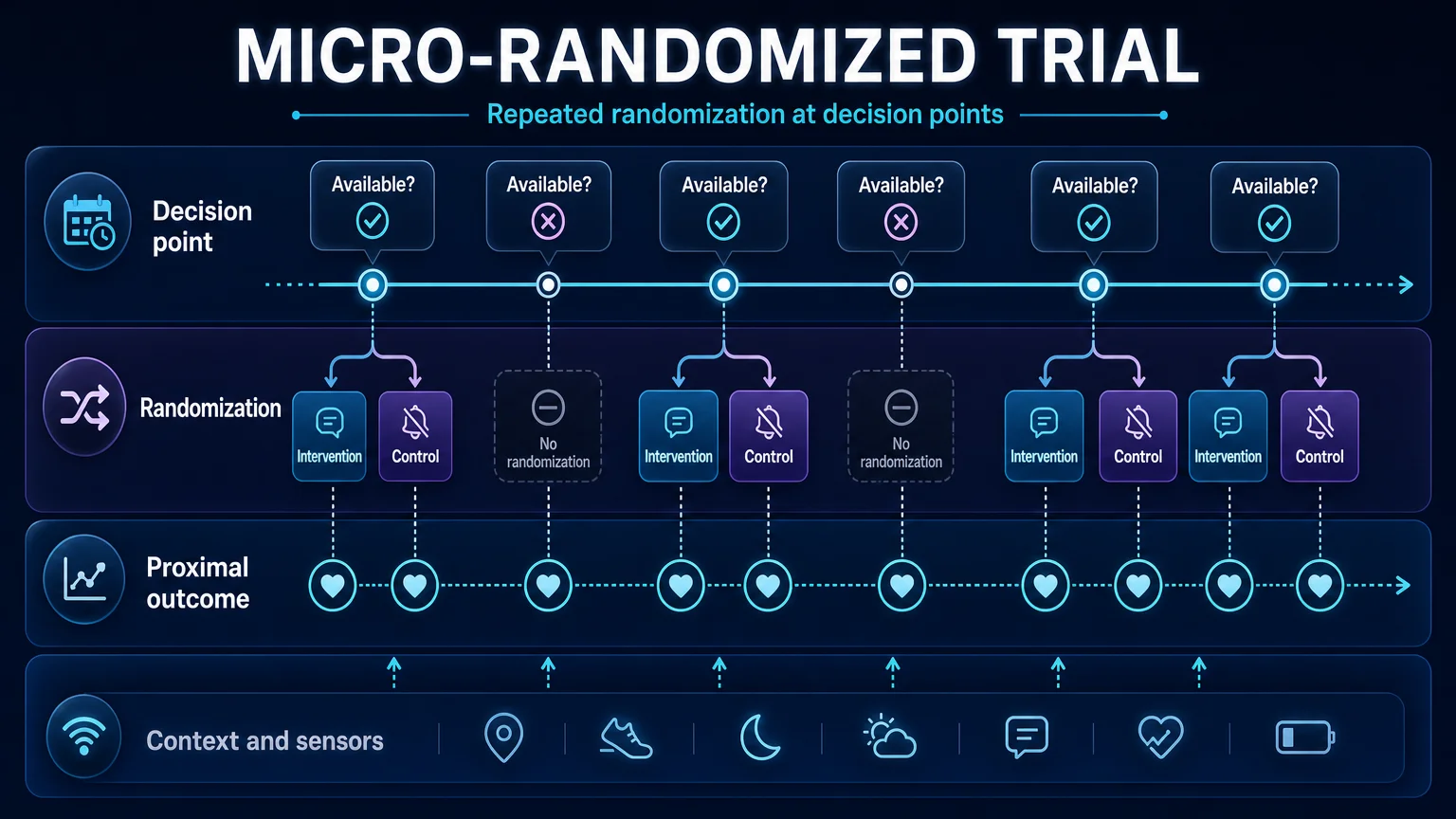


What an MRT is designed to answer
An MRT is not simply a trial with a large number of observations. Its repeated randomizations answer a particular class of causal questions. At a decision point, the investigator defines whether a participant is available for an intervention component. If available, the participant is randomized to one option, such as a prompt versus no prompt or message A versus message B. A proximal outcome is then measured over a prespecified short interval. Repeating this process creates information about the average short-term effect of that component and how the effect changes with time-varying context.
| Design element | Question it supports | What must be specified |
|---|---|---|
| Decision point | When could the component plausibly affect the participant? | Time grid, event trigger, availability window, and measurement schedule. |
| Availability | When is randomization meaningful and deliverable? | Operational definition, exclusion rules, device connectivity, and adherence monitoring. |
| Repeated randomization | What is the causal effect of each option at that moment? | Randomization probabilities, treatment options, and implementation fidelity. |
| Proximal outcome | Did the component produce a short-term response? | Outcome window, timing, scale, missingness, and relation to the intervention mechanism. |
| Moderator | When or for whom does the effect vary? | Context variables, interaction terms, prespecified hypotheses, and multiplicity control. |
Decision points, availability, and randomization
The decision point is the unit of opportunity. It may occur at fixed times, after a sensor-defined state, or after a participant reports a need. The choice should reflect the intervention mechanism rather than the convenience of data collection. If an intervention is intended to reduce sedentary time, randomizing a prompt only when the participant is awake, carrying the device, and not already active may be more informative than randomizing at every clock hour.
Availability is not a minor eligibility variable. If a participant cannot receive the intervention because of sleep, driving, technical failure, or a competing intervention, randomizing the unavailable participant can dilute the estimand and create implementation problems. Availability must therefore be recorded at every decision point, with the reason for non-availability when feasible. The analysis population for a proximal effect is generally defined through the design’s availability rule, not by post hoc removal of inconvenient observations.
Randomization probabilities may be constant or may vary by decision point. Unequal probabilities can protect burden, reduce intervention fatigue, or allocate more opportunities to a clinically promising component. The probabilities must be known or reproducibly generated, because they are part of the design and analysis. If treatment delivery deviates from assignment, the primary intention-to-treat-like proximal effect remains tied to randomization; per-protocol interpretations require additional assumptions and should not be substituted silently.
Proximal outcomes and causal estimands
The proximal outcome is deliberately close to the intervention component in time. A message intended to reduce craving may use craving over the next hour; a prompt intended to increase activity may use steps during a subsequent window. The outcome must be clinically meaningful enough to support the intervention mechanism, but short enough that competing events and long chains of treatment exposure do not overwhelm the interpretation.
The principal estimand is often a causal excursion effect: the contrast in the expected proximal outcome if an eligible participant received one intervention option rather than another at a decision point, averaged over the observed distribution of history and context. This is not automatically the effect on a distal endpoint such as hospitalization, remission, or long-term mortality. A statistically precise proximal effect may fail to translate into durable clinical benefit if the component is burdensome, effects decay rapidly, or repeated exposure changes behavior.
Time-varying moderation asks whether the effect differs by variables measured before randomization at that decision point. Candidate moderators may include recent stress, location, time of day, prior activity, symptom burden, or treatment history. Moderation terms should be prespecified or clearly labeled exploratory. A large collection of interaction terms can produce unstable findings, especially when availability is rare or the effective number of randomized opportunities is smaller than the raw row count suggests.
Analysis of the repeated person-time data
MRT data usually contain multiple rows per participant and many decision points per day. The treatment indicator is randomized only at available opportunities, while the outcome may be missing because the participant does not respond or the sensor fails. A valid analysis must preserve the decision-point structure and account for within-person dependence.
Common analyses use a weighted and centered treatment indicator in a longitudinal regression model, with participant-level clustering or robust standard errors. The model may include time functions, baseline characteristics, time-varying moderators, and treatment-by-moderator interactions. The randomization probability and availability rule determine how treatment is centered and weighted. The exact estimator should be chosen from the estimand and design, not copied from a standard parallel-arm RCT.
Sample size and information in an MRT
More decision points do not create unlimited independent information. The effective information depends on the number of participants, the number of available opportunities, treatment randomization probabilities, within-person correlation, outcome variance, and the strength of any time-varying moderation. A trial with many opportunities but little variation in availability or treatment uptake may have less information than its row count suggests.
Sample-size planning should therefore use design-based simulation whenever the decision schedule, missingness, autocorrelation, moderation, or treatment burden is complex. The simulation should reproduce the expected number of decision points, availability process, randomization probabilities, proximal outcome model, clustering, and the effect size that would be clinically meaningful. Reporting only a conventional two-arm sample-size calculation can misrepresent the precision of an MRT.
Data quality and implementation risks
Digital trials add measurement and delivery risks. Device non-wear, delayed notifications, battery failure, missing ecological momentary assessments, changes in operating-system permissions, and intervention fatigue can all affect availability and outcome measurement. These are not merely technical footnotes. If data capture or delivery changes over calendar time, the estimated effect may mix intervention efficacy with implementation drift.
Researchers should monitor randomization balance at eligible opportunities, treatment delivery, response latency, missing proximal outcomes, participant burden, and changes in the number of available decision points. Diagnostics should be defined before unblinding outcome patterns when possible. The analysis should distinguish a failure to deliver an assigned component from a null biological or behavioral effect.
Five-step MRT workflow
| Step | Action | Deliverable |
|---|---|---|
| Step 1: Define decision points | Specify when the intervention component could plausibly affect the participant and define the proximal outcome window. | Decision-point and outcome map. |
| Step 2: Specify availability | Define when randomization is meaningful, record unavailable reasons, and assess device and delivery constraints. | Availability rule and implementation log. |
| Step 3: Prespecify randomization | Set intervention options, probabilities, burden limits, and any stratification or dynamic allocation features. | Randomization schedule and allocation documentation. |
| Step 4: Model proximal effects | Use an estimand-aligned longitudinal model with treatment centering, clustering, and prespecified moderators. | Effect estimates, uncertainty intervals, and moderation results. |
| Step 5: Report diagnostics | Summarize availability, adherence, missingness, balance, sample-size assumptions, and the boundary between proximal and distal claims. | Transparent analysis and reproducible reporting package. |
Evidence Summary Table
| Source | Evidence role | Practical contribution |
|---|---|---|
| Klasnja et al., Health Psychology 2015 | Foundational methods article | Defines MRTs for JITAI development, proximal effects, repeated decision points, and time-varying moderation. |
| Liao et al., Statistics in Medicine | Sample-size methodology | Provides design-based considerations for planning MRTs in mHealth settings. |
| Qian et al., stratified MRT design | Design extension | Addresses stratification and nested causal effects when decision-point risks vary. |
| Data collection and management guidance | Operational methods | Highlights data quality, device burden, missingness, and implementation issues in intensive longitudinal studies. |
| ICH Efficacy Guidelines | Regulatory context | Provides broader context for estimands, clinical interpretation, and transparent trial reporting; MRT-specific claims still require design-specific justification. |
Common reporting errors
- Calling a high-frequency longitudinal study an MRT without describing the randomization at each decision point.
- Failing to define availability and then interpreting unavailable opportunities as treatment failures.
- Reporting proximal effects as evidence of long-term clinical benefit without a distal outcome analysis.
- Ignoring within-person clustering or using a model that does not match the randomization probabilities.
- Testing many moderators without prespecification, multiplicity control, or uncertainty reporting.
- Reporting the number of rows instead of the number of participants, eligible opportunities, randomized opportunities, and observed proximal outcomes.
Researcher’s Toolkit
Use Lingcore SCI tools to connect MRT design, analysis, and publication decisions:
- Paper Analyzer: audit MRT randomization, availability rules, proximal outcomes, and causal claims.
- Review Builder: organize JITAI and MRT evidence with traceable citations and design comparisons.
- Journal Matcher: identify journals aligned with digital health, clinical trials, biostatistics, and intensive longitudinal methods.
Conclusion
Micro-randomized trials are designed for a narrow but important problem: learning how intervention components work at repeated, context-dependent decision points. Their strength comes from aligning randomization, availability, proximal outcomes, and time-varying moderators. Their limitations are equally important. Repeated observations do not eliminate within-person dependence, high-frequency opportunities do not guarantee adequate information, and a short-term causal effect does not establish long-term clinical benefit. A credible MRT report makes the decision schedule, randomization mechanism, availability rule, estimand, analysis model, diagnostics, and interpretation boundary visible.